

Grace O’Connor (Palmer)
Click the button below to make a donation in memory of Grace O’Connor (Palmer)
Published in Reynolds Club Magazine in April 2026
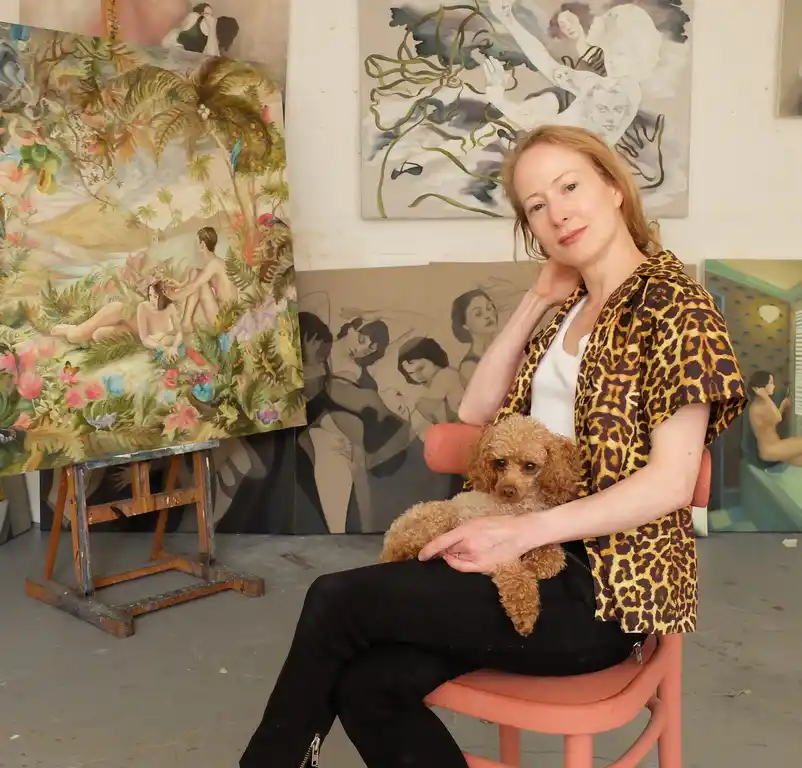
It is with great sadness that we announce the death of Grace O’Connor. She passed away in February 2026 after a long battle with Motor Neuron Disease.
Grace was a renowned artist and former student at the Royal Academy Schools (1996-1999). She began her artistic journey as a child growing up in Waterbury, Connecticut USA. The youngest of seven children she displayed remarkable talent from an early age drawing anywhere and everywhere. When her mother would take all the children to Sunday Mass, Grace would grab a bulletin and spend the entire service drawing figures, much to the delight of the children seated in the pew behind her. Grace was completely self-taught. The few times her mother enrolled her in art classes, she would inevitably annoy the teachers because she knew better how her painting or drawing should look. At the age of fourteen she was given her first solo exhibition at a museum in New Haven, Connecticut.
Grace was utterly driven and at the age of seventeen left the USA, having been accepted at the Chelsea school of Art. Her parents agreed to let her go after she talked up the prestige of the school, but Grace was an Anglophile and dreamed of living in England. She had travelled on holiday with two of her sisters to the UK the year before. On that trip Grace brought along rolled up canvases and she and her sister Nora began knocking on gallery doors asking to show her work to the owners. They happened upon a gallery on Albermarle Street called the Albermarle Gallery and went in.
Nora introduced herself to the owner Rodney Capstick-Dale and his wife Diana because Grace was too shy to speak. At this point Grace had no idea who Rodney was, and he kindly offered to look at her work. Grace always said that Rodney ad Diana simply took pity on her because she was too naïve to understand how hopeless her quest was. They were both however, enormously impressed with her work and could see talent and potential in this fledgling youth. Rodney, one of most recognized and sought-after dealers both in London and on the international art market, took Grace under his wing and there began a lifelong friendship. She packed a bag, left the USA, travelled alone to London, found digs and began her new life. Chelsea was short-lived, however. Once again Grace bucked the system, outgrew the teaching and left after one term.
Grace quickly found work with Norman Singh, a highly regarded scenic background artist at that time. Together they painted huge backdrops for Top of the Pops and countless television advertisements and music videos. It was a busy and intense work schedule. Every week they would have to deliver several new backdrops for the different TOTP performances and this experience taught Grace how to work on a large scale and fast – speed was one of her trademarks.
Rodney began introducing Grace to the London art world and soon after she was offered her first solo show at the Submarine Gallery in King’s Cross. In the meantime, she still needed to pay the rent and continued working with Norman Singh. She painted prolifically
in her spare time.
In 1994 Grace won the Hunting Young Artist of the Year prize. This was the crowning glory to her early career and opened many doors. She was shown by Beaux Arts and the Boundary Gallery in London and her paintings were being bought now by private collectors.
Despite her early success, Grace felt ready to return to art school and intuitively grasped the fact that if she was given the opportunity to learn from great artists and truly refine her technique, it would make her a better painter. She applied to the Royal Academy Schools in 1996 and was offered a place. There, under the tutelage of some of the greatest British contemporary artists, notably Norman Blamey RA, Maurice Cockrill RA, Timothy Hyman RA and Keeper of the Schools, Leonard McComb RA, Grace learned her craft the way she had always wanted to – the traditional way in the Life Room. Her tutors, especially Timothy Hyman, remained lifelong friends, and Leonard even painted a portrait of Grace while she was a student at the RA. The painting is hanging in the Glasgow Museum of Art.
Grace’s degree show sold out and almost immediately after graduation she was invited to show in a group exhibition at the Paton Gallery, owned by Graham Paton. Graham Paton was a true champion of Grace’s and established her firmly as a mature and polished artist who could translate themes and ideas into superbly crafted and magical paintings. Her memories of childhood and growing up in small town America found their way into a seminal body of work that would stamp her identity on a style of painting that was uniquely hers. It was in the Paton show that Grace also began exploring the juxtaposition of animals and birds in the landscape, a motif that became one of the main identifying characteristics of her later work. Needless to say, the show was a sell-out.
Sadly, Graham announced his retirement after the exhibition. He said he wanted to go out on a high, and he certainly accomplished that, but Grace was bereft because she felt she had finally found her home with Graham. With her burgeoning reputation she was immediately taken on by Long and Ryle where she showed the following year. It was another successful exhibition and enabled Grace to develop further the concept of birds in paintings, a subject that would come to dominate her oeuvre. It was around this time that Grace met the gallerist and dealer Paul Stolper who owns Paul Stolper Gallery. They discovered a great commonality and shared love of the same artists, musicians and writers. Paul was a natural fit for Grace, and he continues to represent her to this day. He gave her numerous solo shows over the last twenty-five years and he would always quip that he could never sell enough of her bird paintings and would implore her to paint more of them. Grace, knowing their value, and the value of her reputation, limited the output to perhaps two paintings a year even though she could easily have painted three a week if she set her mind to it!
Three young children, a dog, and a husband who was often working away from home for long stretches at a time never dampened Grace’s spirit and drive to keep painting. She juggled family life single-handedly with painting in her treasured Acme studio in Bethnal Green. As soon as she had dropped the children off at school she would rush to the studio on the tube. She was enormously productive every day before having to return in time for school pick-ups. She even spent her evenings teaching drawing online to students at the Art Academy University in San Francisco, and designing syllabi for the college. Grace’s output was truly prodigious.
In 2018 Grace began a collaboration that would define her final years and is sure to leave a legacy of great value to both the worlds of literature and art. Simon Draper, a partner of Richard Branson’s from the early days of Virgin Records and an avid collector of fine art and motor vehicles, is the owner of Monkton House, once the residence of flamboyant 1920s society couple, Edward James and Tilly Losch. The house has been untouched since then. It is steeped in history and retains the decadent glorious design of the era. Simon had taken an interest in Grace’s work. Grace meanwhile was fascinated by stories of James and Losch’s unconventional marriage and the way they imbued Monkton House with the types of trappings, quirks and design idiosyncrasies that reflected their glamorous yet flawed lifestyles. Simon gave Grace a tour of the property and Grace proposed making a series of paintings that captured the world, both real and imagined, that Edward James and Tilly Losch inhabited in their travels around the world together, and at Monkton. Grace was already in the advanced stages of Motor Neuron Disease, but still able to hold a paintbrush, when she finished the paintings.
The story does not end there however. The celebrated writer Michael Bracewell recently began writing a large-format illustrated book about the lives and travails of Edward James and Monkton House. The manuscript was completed in 2025 and after being introduced to Grace’s work by Simon Draper, Michael Bracewell asked for all her paintings to be used exclusively for the book’s artwork. In the final few weeks of her life Grace was busy corresponding with Michael over the picture selection and layout. This partnership brought Grace a creative satisfaction that made the darkest days of her illness full of light and optimism. She remained immensely grateful to Michael and Simon for including her in their project. Her one wish was to stay alive long enough to see the book published but sadly that was not to be.
When Grace lost the use of her hands, she refused to admit defeat and turned to using her mouth to hold the paintbrush. As was so typical of her determination and bright outlook in the face of adversity, she quickly became very adept at this method and was as productive and meticulous as ever, often painting for hours at a time, listening to the Beatles, and audiobooks on Stanley Kubrick – her two most enduring obsessions! In 2022 Grace and the family moved to Mystic, Connecticut as her husband Tim had taken a faculty position at Boston University. For the last two summers, Grace had been selected for the Mystic Museum of Art summer show with work she had painted by mouth. The prestigious Aldrich Museum in Connecticut chose several of Grace’s paintings to exhibit in a group show that opens in June 2026. Again, this was one more thing that Grace was holding out for and gave her a reason for continuing in the face of what must have been unimaginable physical and mental anguish. Never losing her wit or humour, she said, “I’ve been trying to get into the Aldrich for twenty years and now they give it to me!”
Grace O’Connor (? – she never gave her age – February 6th, 2026)
She is survived by her husband Tim, cinematographer and professor at Boston University, her two sons James and Thomas, both at university, and her daughter Elizabeth, attending high school. She leaves behind her six siblings including her beloved sisters Nora, Deirdre and Margaret who did so much to support her in her final years, and her father John O’Connor.
The charity, Compassionate Care ALS (CCALS), provided an extraordinary level of assistance in every way for four years, and extended her the greatest lifeline with the generous donation of what she fondly called her ‘eyeball computer’. This allowed Grace to keep communicating, writing, reading and listening – all the things she loved doing most – until the very end.
CCALS never asked for anything, and the caring staff are completely selfless. They have all been affected one way or another by Motor Neuron Disease (ALS in the United States) Any donation would be most welcome, and Grace would undoubtedly feel that it would be a thank you gift from her.